In 21st Century American Progressives find themselves lost in a sea of words which opponents use to confuse, hide, or sublimate their message. Progressives know that in the 20th Century their message was accurately expressed by Teddy Roosevelt:
“Liberals” generally today in the United States focus on using taxpayer money to help create better society.
“Progressives” focus on using governmental power to make large institutions play by a set of rules “Progressives” use a "progressive tax structure" to fund local, state, and federal government activities such as providing streets and highways, schools, medical services, and defense. The goal is to create equitable communities and an equitable world.
Importantly, Progressives are aware of history and know that Teddy Roosevelt was cast out by the Republicans and rejected by the Democrats - he had to create his own political movement. As explained in this website, the 21st Century Neoliberal takeover of the state Republican Party organizations and the Third Way takeover of the National Democratic Party effectively shuts out the Progressive Pacific Message which is presented here on this blog (use link near the top of the page) as well as on our website (use link below).
Showing posts with label Democrat. Show all posts
Thursday, January 11, 2018
Sunday, January 1, 2017
Dissidents in American Politics:
2016, The Most Depressing and Ominous
Presidential Election Year Since 1860
The year 2016 had become the most depressing and ominous Presidential election year since 1860. Then out of the fog came Michelle Obama....
This is a face and voice of a 20th Century American telling 20th Century Americans what we should known, that 2016 would become the year we decided what life will be like in 2050 for Americans age 16 and younger - telling us that the focus of our nation over the next decade should not have been about the needs of people who voted for Jack Kennedy or Ronald Reagan.
As Hillary Clinton said:
(As an aside, we need to note that the Democratic Party survived only because the outsider who attacked it was unsuccessful. Bernie Sanders was never a Democrat and has declared he will continue to serve in the Senate as an independent. Political parties are, of course, private organization whose members and staffs work hard to elect majorities in the Senate, House, and state legislatures where public policy is made.)
One can't help but ponder, to consider the historical context, about how too many 20th Century American dissident voters (and yes, all current voters were born in the 20th Century) brought America back to where we are today.
It is not like vocal dissidents are a new thing, but what we've seen this year is the worst that is embedded within the American soul. This, at least partially, is the result of an unforgivable ignorance of American and world history, particularly political and economic history.
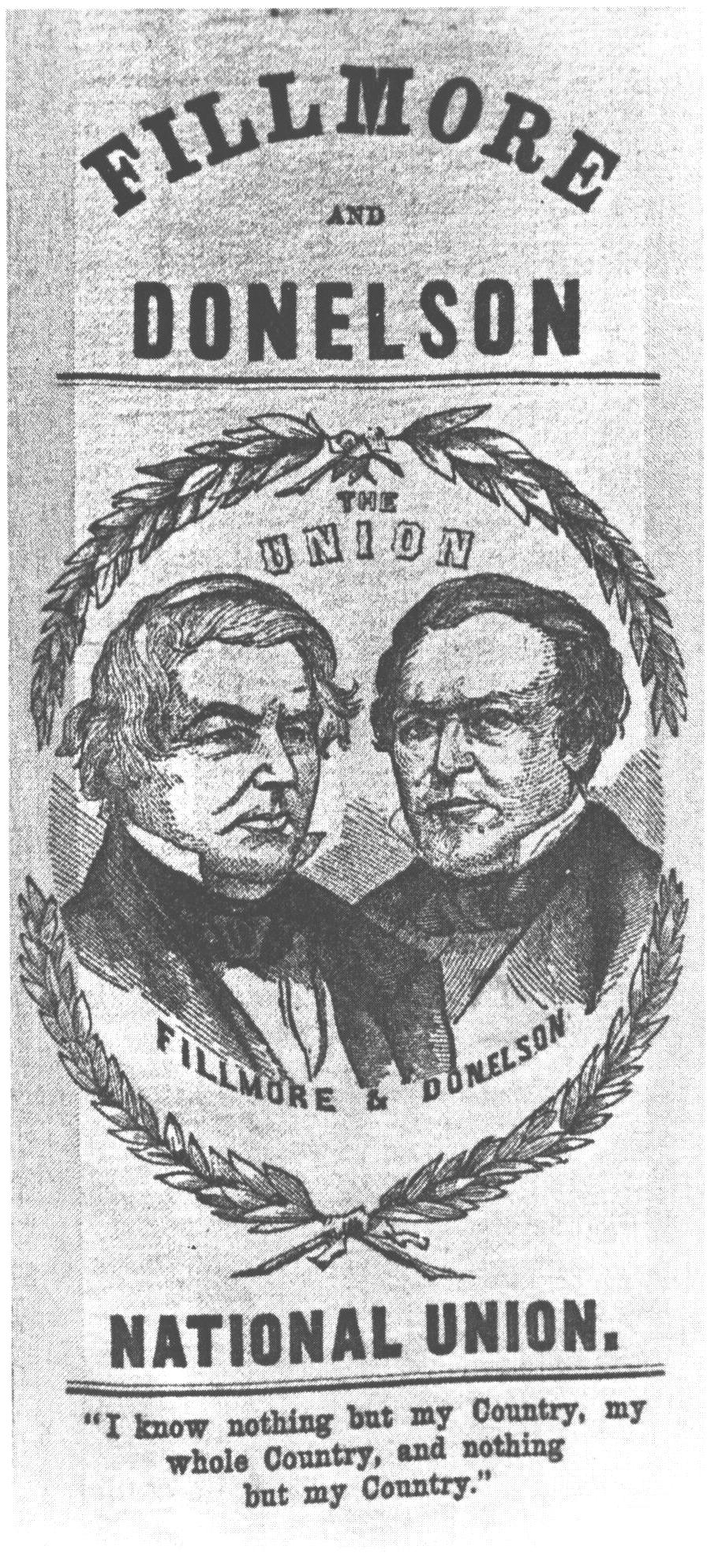
Voters' attitudes are painfully reminiscent of the "Know Nothing" movement of the 1850's which arose in response to an influx of Irish and German Catholics and other immigrants, thus reflecting nativist and anti-Catholic sentiment (though in California it was based on opposition to Chinese immigration). It resulted in former President Millard Fillmore running for President in 1856 on the American Party ticket, winning 23% of the popular vote and carrying one state.
It may seem like this is just what happens in America. But history has details that the broad strokes don't tell you.
Yes, if you add to Nicolle Wallace's words "protectionism", "isolationism", and "nativism" the anti-Muslim anti-Hispanic bigotry of Donald Trump's rhetoric and you might think you have Millard Fillmore reborn, just with Islam substituted for Catholicism.
Except that unlike Trump, Fillmore was a knowledgeable, experienced public official who, when it came to government administration and public policy, "had a clue" as they say.
Prior to his run for President on the American Party ticket, Fillmore was an Inspector of the New York Militia's 47th Brigade with the rank of Major, an attorney, a New York State Assemblyman, a Congressman as a Whig Party candidate, a Vice-President as a Whig, and a President as a Whig after the death of President Zachary Taylor.
In Trump we have as a President someone that spent his life as a con man who gained notoriety as a reality show host. A reality show host....
This happened because we are in a time in which our political discussion has been reduced to the divisiveness of uninformed, dismissive, content-free, frequently hate-filled tweets.
We have literally created in the form of "apps" the mechanism to amplify the worst in ourselves, the worst in America, creating the worst kind of dissidents.
Because those "apps" - whether they are tweets, Facebook posts, or news web sites - generate corporate revenues, they proliferate becoming the source of "The Conventional Wisdom" instead of truthful facts.
For those who do not understand the term "The Conventional Wisdom", economist John Kenneth Galbraith in his 1958 book The Affluent Society prepended "The" to the phrase "conventional wisdom" to emphasize its meaning narrowed to those commonplace beliefs that easily became acceptable and comfortable to society, thus enhancing their ability in the minds of people to resist facts that might diminish or belie them.
In contrast to tweets, offered "for the record" are ruminations on early 21st Century American politics in an historical context, adapting an early-20th-Century-magazine-article-style long-form format divided into 10 more long, though hopefully provocative and/or informative, blog posts. Below is a linking "table of contents":
Revised from the Original Post in the Redwood Guardian
As Hillary Clinton said:
“Stronger Together” is not just a lesson from our history. It's a guiding principle for the country we've always been and the future we're going to build. So let's be stronger together. Looking to the future with courage and confidence. Building a better tomorrow for our beloved children and our beloved country.In contrast, in 2016 the 20th Century Republican Party has been declared dead and reborn. Longtime GOP strategist for President George W. Bush and for Senator John McCain, Nicolle Wallace, recently bemoaned that Republican Party candidate is "a man who believes in protectionism, isolationism, and nativism."
(As an aside, we need to note that the Democratic Party survived only because the outsider who attacked it was unsuccessful. Bernie Sanders was never a Democrat and has declared he will continue to serve in the Senate as an independent. Political parties are, of course, private organization whose members and staffs work hard to elect majorities in the Senate, House, and state legislatures where public policy is made.)
One can't help but ponder, to consider the historical context, about how too many 20th Century American dissident voters (and yes, all current voters were born in the 20th Century) brought America back to where we are today.
It is not like vocal dissidents are a new thing, but what we've seen this year is the worst that is embedded within the American soul. This, at least partially, is the result of an unforgivable ignorance of American and world history, particularly political and economic history.
Voters' attitudes are painfully reminiscent of the "Know Nothing" movement of the 1850's which arose in response to an influx of Irish and German Catholics and other immigrants, thus reflecting nativist and anti-Catholic sentiment (though in California it was based on opposition to Chinese immigration). It resulted in former President Millard Fillmore running for President in 1856 on the American Party ticket, winning 23% of the popular vote and carrying one state.
It may seem like this is just what happens in America. But history has details that the broad strokes don't tell you.
Yes, if you add to Nicolle Wallace's words "protectionism", "isolationism", and "nativism" the anti-Muslim anti-Hispanic bigotry of Donald Trump's rhetoric and you might think you have Millard Fillmore reborn, just with Islam substituted for Catholicism.
Except that unlike Trump, Fillmore was a knowledgeable, experienced public official who, when it came to government administration and public policy, "had a clue" as they say.
Prior to his run for President on the American Party ticket, Fillmore was an Inspector of the New York Militia's 47th Brigade with the rank of Major, an attorney, a New York State Assemblyman, a Congressman as a Whig Party candidate, a Vice-President as a Whig, and a President as a Whig after the death of President Zachary Taylor.
In Trump we have as a President someone that spent his life as a con man who gained notoriety as a reality show host. A reality show host....
This happened because we are in a time in which our political discussion has been reduced to the divisiveness of uninformed, dismissive, content-free, frequently hate-filled tweets.
We have literally created in the form of "apps" the mechanism to amplify the worst in ourselves, the worst in America, creating the worst kind of dissidents.
Because those "apps" - whether they are tweets, Facebook posts, or news web sites - generate corporate revenues, they proliferate becoming the source of "The Conventional Wisdom" instead of truthful facts.
For those who do not understand the term "The Conventional Wisdom", economist John Kenneth Galbraith in his 1958 book The Affluent Society prepended "The" to the phrase "conventional wisdom" to emphasize its meaning narrowed to those commonplace beliefs that easily became acceptable and comfortable to society, thus enhancing their ability in the minds of people to resist facts that might diminish or belie them.
In contrast to tweets, offered "for the record" are ruminations on early 21st Century American politics in an historical context, adapting an early-20th-Century-magazine-article-style long-form format divided into 10 more long, though hopefully provocative and/or informative, blog posts. Below is a linking "table of contents":
- Dissidents in American Politics: "Left", "Right", "Conservative" and "Liberal" are Meaningless Labels
- Dissidents in American Politics: The 21st Century Political Divisions within a Divided, Disintegrating American Union
- Dissidents in American Politics: The History of the Authoritarian Presidency
- Dissidents in American Politics: Who are we angry at? The Ethnic Others? Politicians, Congress, State Legislatures? Or the Sort of Rich, Rich, & Stinking Rich?
- Dissidents in American Politics: The Shareholder Capitalist Class
- Dissidents in American Politics: The Academic Oligarchist Class
- Dissidents in American Politics: The Romantic & Mythical in Politics
- Dissidents in American Politics: Shareholder Capitalists versus Academic Oligarchists
- Dissidents in American Politics: The Prospect of a Revolution and Tyranny led by American Mythical Reactionaries
- Dissidents in American Politics: Beliefs, Facts, and Future Shock
1. Dissidents in American Politics:
"Left", "Right", "Conservative" and
"Liberal" are Meaningless Labels
"Dissidents" are people who actively challenge established doctrine, policy, or institutions. This post is the first in a series of 10 posts regarding the confusing "revolutions" of the 2016 Presidential Election.
The political terms Left and Right were coined during the French Revolution (1789–1799), referring to the seating arrangement in the Estates General:
- Those who sat on the left generally supported the revolution including the creation of a republic and secularization;
- Those who sat on the right were supportive of the traditional institutions of the Old Regime including the monarchy and a strong belief structure derived from a revered book of beliefs we call "religious."
In many ways it was weird that those terms were incorporated into the political language of the United States; after all, the American Revolution created a secular republic.
If that isn't bad enough, we English speakers then divided into "left" and "right" the two extreme 20th Century implementations of tyrannical, totalitarian dictatorships - Nazi Germany and the Soviet Union - both of which embraced a strong, religious-like belief structure derived from a revered book.
It is even harder to understand logically how we got from there to a broad acceptance of the idea that...
- the American right is laissez-faire capitalism based on the reactionary writings of Russian immigrant Ayn Rand - Alisa Zinov'yevna Rosenbaum. a member of a Jewish bourgeois family born in 1905 and raised in Russia - who, after the Russian Revolution opened universities to women, was in the first group of women to enroll at Petrograd State University and who in her later years was a lecturer at Yale, Princeton, Columbia, and Harvard; and
- the American left is libertarian socialism influenced among others by Robert Owen's experiment in New Harmony, Indiana, by the Nonpartisan League's North Dakota tradition of government rejection of big business, and more recently by the reactionary writings of Noam Chomsky (born in the United States of Eastern European immigrant Ashkenazi Jewish parents) who was educated at the University of Pennsylvania
What is odd is that politics and economics as academic studies somehow became separated in the minds of serious, but confused, people. Perhaps it is time we Americans remind ourselves of something:
In the 21st Century, as it was in the 20th Century and half of the 19th Century, paper (and now digital) money is a central government created and controlled commodity.
For our first 65 years, from the founding of the United States to the passage of the National Banking Act, some 8,000 different entities - mostly state charted banks - engaged in the highly profitable business of issuing currency. In addition to encouraging rampant counterfeiting, this created an unreliable money supply as frequently these banks would fail. It also created a multitude of local economies, interfering with travel even between cities, much less between states.
Without going into all the complexities, by establishing a single national currency during the Civil War, the National Banking Act eliminated the overwhelming variety of paper money circulating throughout the country thereby facilitating a true national economy.
To put it as simply as possible, the central government controls the supply of money through monetary policy and assures its acceptance as "legal tender" so that payment for labor and goods can be accomplished reliably. Further, the value of an asset - property - is measured by what someone would pay for it in dollars - federal reserve notes - not in pumpkins or "Bank of Nome Alaska" notes.
(As a side comment, Brexit is about money. It is no coincidence the United Kingdom never substituted the Euro for the Pound. The UK was only "sort of half in" when it came to the European Union. Thus in part the Brexit vote ironically reflected the reluctance of those who opposed Brexit to be a full participant in the first place.)
By definition, an economy depends upon the money supply and in the 21st Century it is the government's responsibility to see that an economy works. Government is controlled by politics. Therefore, politicians facilitate the economy. Remember this fact - politicians facilitate the economy, economists ruminate on the idea of an economy, businesses take advantage of the economy, workers struggle to survive and sometimes they can strive to be comfortable in an economy.
On the other hand, a government has a hard time coping with the impact of what people do with the money they are allowed to keep - after taxes sends some of that money back to its creator. Not to be repetitive, money is a government created commodity in the first place.
It is the dispute over how much wealth (measured in money) individuals and corporations can control versus how much the government controls that supposedly is reflected in the popular labels "left" and "right."
What that has to do with gay marriage and being "liberal" or "conservative" demonstrates just how confusing these labels are and how little we understand the role of government in our society.
With the advent (the arrival of a notable person, thing, or event) of Brexit into British politics and Donald Trump into American politics, it's time for English speakers to toss the political terms "left" and "right" into the scrap heap of history. And based upon the vote in Britain and the weakness of the parties in the United States, we should reconsider our use of the labels "liberal" and "conservative" in politics.
In the next post of this series, I will discuss proper labels for people actively participating in politics and the economy either as members of "The Establishment" or as "dissidents."
2. Dissidents in American Politics:
The 21st Century Political Divisions within
a Divided, Disintegrating American Union
"Dissidents" are people who actively challenge established doctrine, policy, or institutions. This post is the second in a series of 10 posts regarding the confusing "revolutions" of the 2016 Presidential Election.
In the 21st Century, our nation, if not the world, has clarified how to classify people in the context of the political and economic milieu. People engaged in the political/economics milieu fall into one of two divisions and one of four classifications:
- An Establishment including:
- Shareholder Capitalists who run the world's economy, and
- Academic Oligarchists who run the national governments;
- Authoritarian Revolutionary dissidents opposing "The Establishment" including:
- Romantic Populists who believe that the "virtuous" citizens are being mistreated by a small circle of elites and favor the "proper" division of economic resources through a government imposed sharing society, and
- Mythical Reactionaries who believe that "once upon a time" there was a state of society which possessed characteristics such as discipline, respect for authority, etc., that are absent from contemporary society and favor a government imposed return to that state of society.
In the 21st Century world through experience (See Arab Spring) we have learned that the likelihood of a successful relatively peaceful democratic non-authoritarian revolution is slim mostly because of that disengagement. The likelihood of a successful violent democratic non-authoritarian revolution similar to the American Revolution is also slim as the French learned when their revolution culminated in a dictatorship under Napoleon.
What we need to understand is that in the history of the world positive government change towards a non-authoritarian model is achieved mostly in an evolutionary process such as occurred in the United Kingdom.
As we shall explore later, the division of powers within the American Constitution creating a stronger Union government was necessary to replace a weak, failing government established under the Articles of Confederation and one of those divisions created the position of President in which intuitive authoritarian powers were vested.
In response to the rise of Donald Trump, early on in this Presidential Election cycle we began to be offered in news commentary and in-depth articles on the 1990's-2000's research of political scientists who have defined "authoritarianism" as a psychological profile of a people. Under the right conditions, people will desire certain kinds of extreme policies and will seek or favorably respond to strongman leaders - demagogues - to implement them.
This year the rabid supporters of Bernie Sanders and Donald Trump have made it clear that a large number of voters desire an authoritarian revolution, though they are somewhat divided in orientation between over-40 reactionary ultra-nationalists (Trump supporters) and the under-40 populist multi-culturalists (Sanders supporters).
From the beginning it rapidly became clear that the rabid Trump supporters are supporters of authoritarian government. It wasn't until the majority of Democratic Party voters selected Hillary Clinton that the rabid Sanders supporters indicated they are also supporters of authoritarian government when they clearly rejected the democratic outcome in favor of imposing their own sense of order and correctness on the majority.
We also saw that generally the younger the voter age, the more likely a dissident will embrace populist multi-culturalism while seeking economic change through authoritarian actions by a President. Generally, the older the voter age, the more likely a dissident will embrace reactionary ultra-nationalism while seeking economic change through authoritarian actions by a President.
This split is at least partially the result of two terms seemingly with a common root - communications and community. (After all, "commune" has two different definitions: (1) a noun, a group of people who live and work together and share responsibilities; (2) a verb, to converse or talk together, usually with profound intensity, intimacy, etc.)
The younger the voter's age, the more likely the voter will have embraced the early 21st Century communications system - the internet and text messaging - which creates a sense of participation in a broad multi-cultural, even international, community, but without actually contacting another human where "contact" is traditionally defined as "the act or state of touching; immediate proximity or association."
In addition, their heavy personal device use reduces direct human interaction within the local geographic community creating a sense of isolation from groups, clubs, organizations, such as the political party system which is structured from local party "central committees" which participate creating the national party.
This has created a misuse of the word "community" where people think a community exists because of interactions on Facebook and the like - where participants have interactions with others for whom they have no responsibility for their well-being as breathing mammals beyond impersonal devices like GoFundMe.
The older the voter's age, the more likely the voter does not use the internet or text messaging, or does not use it as extensively. In the 21st Century these people have continued sense of participation in a geographic community of friends, family, and older co-workers - people they know in person from direct face-to-face interaction.
On the other hand, these older voters are more isolated from. and usually fearful of, the rapidly changing face of the broader American community and the very foreign international community. It creates a sense of isolation from the late 20th Century national political party systems where national leaders in both the national Democratic and Republican parties had a strong sense of internationalism.
Most of these older voters do understand that the grassroots "Tea Party" Mythical Reactionaries have impacted on the Republican Party. However. most Americans do not know that since the 1992 a well-financed sophisticated organization of extremely conservative Shareholder Capitalists - the State Policy Network - has successfully implemented a specific goal of taking over the state governments and Congress using those "tea party" folks.
While age and other factors may tend to divide dissidents into Romantic Populists and Mythical Reactionaries, we need to acknowledge something simply expressed by one American stock market analyst:
There are a lot of angry people almost anywhere you care to look, and that anger isn't simply going to blow over. That's what happened in the late ‘60s and all of the 1970’s, and that is what's happening again now.Age difference has not created an anger divide; they are all equally angry at "The Establishment" even if for different reasons. An increase in mass anger means an increase in the number of people who become avid Romantic Populists and Mythical Reactionaries as the number of politically disengaged become angry.
This isn't limited to the United States, as observed by a New York Times Editorial Board Opinion Piece which described the Brexit vote results:
It was a cry of anger and frustration from more than half the country against those who wield power, wealth and privilege, both in their own government and in Brussels, and against global forces in a world that they felt was squeezing them out.The important fact to understand is that most of these angry dissidents are not avid ideologues - most of the large numbers of Romantic Populists and Mythical Reactionaries in the U.S. aren't advocates for some esoteric communist or fascist philosophies which they've studied in detail.
But they do feel the need to immediately and significantly disrupt the complex status quo created by the Shareholder Capitalists who run the world economy as facilitated by Academic Oligarchists who run the national governments. And they want it done by an authoritarian President.
The disengaged really don't care about their country being ruled by an authoritarian President ... until they do.
For ordinary people in Nazi Germany, life was comfortable, and in the period from 1950-1990 many disengaged Germans looked back and remembered accurately their years before 1939 as good years, much better than pre-1932 years. After 1939? Yes, each day they began to care a bit more when it was too late.
Since many Americans do not understand the historical legitimacy of the authoritarian President, we will explore that subject next.
6. Dissidents in American Politics:
The Academic Oligarchist Class
"Dissidents" are people who actively challenge established doctrine, policy, or institutions. This post is the sixth in a series of 10 posts regarding the confusing "revolutions" of the 2016 Presidential Election.
Academic Oligarchists advocate control of government executive and judicial power by people who can be trusted to act on behalf of the "common good." They can be trusted because they have shared ties and knowledge gained through higher education, meaning colleges and universities they have attended.
Membership into the American Academic Oligarchy can automatically derive from holding a degree from an American Ivy League school (Brown, Columbia, Cornell, Dartmouth, Harvard, the University of Pennsylvania, Princeton, and Yale) plus a few others (College of William and Mary, University of Chicago, Duke, Georgetown, Stanford, Wellesley, and the three military academies).
It is important to recognize that Academic Oligarchists are not employed by a university or college, except on a temporary basis or when semi-retired. Nor are they employed regularly in the private sector. Rather they work as elected or appointed public officials.
While the focus here is on the latter half of the 20th Century and the beginning of the 21st Century, the American Academic Oligarchy assumed control at the creation of the United States. Of course our first six Presidents attended one of those colleges:
- George Washington - College of William and Mary
- Thomas Jefferson - College of William and Mary
- John Adams - Harvard
- James Madison - University of Pennsylvania
- James Monroe - College of William and Mary
- John Quincy Adams - Harvard
- John Jay - Columbia
- Oliver Ellsworth - Yale, Princeton
- William Paterson - Princeton
- William Cushing - Harvard
- John Blair, Jr. - College of William and Mary
- Bushrod Washington - College of William and Mary
- John Marshall - College of William and Mary
- William Johnson - Princeton
- Henry Brockholst Livingston - Princeton
- Joseph Story - Harvard
- Smith Thompson - Princeton
- John Hancock - Harvard
- William Hooper - Harvard
- Samuel Adams - Harvard
- Robert Treat Paine - Harvard
- Elbridge Gerry - Harvard
- William Ellery - Harvard
- William Williams - Harvard
- Oliver Wolcott - Yale
- Philip Livingston - Yale
- Lyman Hall - Yale
- Carter Braxton - College of William and Mary
- Benjamin Harrison V - College of William and Mary
- Benjamin Rush - Princeton
- Joseph Hewes - Princeton
- Thomas McKean - Princeton, Dartmouth, University of Pennsylvania
- Francis Hopkinson - University of Pennsylvania
- James Smith - University of Pennsylvania
- James Wilson - University of Pennsylvania
- William Paca - University of Pennsylvania
We all know that Benjamin Franklin, like so many of his time, was educated more informally. That might make you think he wasn't involved in the Academic Oligarchy. What you may not know is the Academy and College of Philadelphia located in Philadelphia was founded in 1749 by a group of local notables that included Benjamin Franklin. Franklin, the first president of the board of trustee, drew up the constitution for the academy, which was notable for its emphasis on modern languages and science in place of Latin and Greek. It was reorganized in 1791 as the University of Pennsylvania.
Twenty-one members of the Continental Congress were graduates of Benjamin Franklin's school, and nine signers of the Declaration of Independence were either alumni or trustees.
Given the times, as we might expect many signers not listed were educated in Great Britain. As an example, John Witherspoon attended the University of Edinburgh but emigrated from Scotland to New Jersey in 1768 to become the sixth President of the College of New Jersey, later known as Princeton University.
While holding a degree from any university, any person can become affiliated with American Academic Oligarchists by working in a senior position for a President, or Cabinet Member, or even a State executive official who is an Academic Oligarchist.
Most significantly, the American Academic Oligarchy controls the U.S. Presidency and Supreme Court. Oh. And did I say that they believe they work to achieve "the common good" which in the 20th Century was defined by The Universal Declaration of Human Rights, a documents most Americans don't even know exists. On other hand, how to achieve "the common good" is the subject of political disputes.
Here is a list of the American Presidents who first entered the office after the adoption of The Universal Declaration of Human Rights, and their alma maters:
- Barack Obama - Columbia and Harvard Law School
- George W. Bush - Yale and Harvard Business School
- Bill Clinton - Georgetown, Oxford, and Yale Law School
- George H. W. Bush - Yale
- Ronald Reagan - Eureka College
- Jimmy Carter - U.S. Naval Academy
- Gerald Ford - Yale Law School
- Richard Nixon - Duke University School of Law
- Lyndon B. Johnson - Texas State University
- John F. Kennedy - attended Stanford and graduated from Harvard
- Dwight D. Eisenhower - United States Military Academy (West Point)
As we know, Lyndon Johnson accidentally became President after the assassination of Jack Kennedy and immediately was surrounded by members of the American Academic Oligarchy who were part of the Kennedy administration. Ironically, because of timing the American Academic Oligarchy in 1964 had to use Johnson, whose leanings were toward being a Romantic Populist, to stop a Mythical Reactionary movement led by Barry Goldwater. Johnson only recently has been posthumously "embraced" by Academic Oligarchs.
By the time Ronald Reagan entered the Office of the President he too was surrounded with automatic members. But he had served two terms as Governor of California 1967–75 with Ed Meese as his Chief of Staff. Meese was a Yale graduate. It is in examining the people like Meese around Reagan's political career that we can gain a clearer picture of what it means to be an Academic Oligarchist.
For instance, a classic example of an Academic Oligarchist associated with Reagan was Caspar Weinberger, who held a BA and a law degree from Harvard.
- Governor Ronald Reagan named Weinberger chairman of the Commission on California State Government Organization and Economy in 1967 and appointed him State director of finance early in 1968.
- Two years later Weinberger became chairman of the Federal Trade Commission where is credited for having revitalized the FTC by enforcing consumer protection.
- Weinberger subsequently served under President Richard Nixon as Director of the Office of Management and Budget and Secretary of Health, Education, and Welfare.
- Weinberger then became vice president and general counsel of the Bechtel Corporation in California directly working in the world of Shareholder Capitalists for what is today the largest construction and civil engineering company in the United States, ranking as the 5th-largest privately owned company in the United States; it was and is a major contractor working for the U.S. Government which, as of July 2015, leads a consortium that manages three national security-related facilities in the U.S.: the Los Alamos National Laboratory, the Lawrence Livermore National Laboratory and the combined Y-12 National Security Complex/Pantex Plant..
- Weinberger then served as Secretary of Defense for the first six years of Reagan's Presidency.
- Afterwards Weinberger joined Forbes, Inc., in 1989 as publisher of Forbes magazine, and in 1993 he was named chairman.
- In he early 21st Century Weinberger was a member of the Founding Council of the Rothermere American Institute of Oxford University.
- In 1968, he signed the Meyers-Milias-Brown Act, establishing collective bargaining for California's municipal and county employees which is consistent with his history as a union leader;
- During his term as Governor, he oversaw adoption of sweeping tax packages at least four times larger than the previous record California tax increase obtained by Governor Brown in 1959;
- In 1970 he signed the landmark California Environmental Quality Act; he worked with Nevada Republican Governor Paul Laxalt to establish the Lake Tahoe Regional Planning Agency to protect the Lake from irresponsible development; he signed the bill that created the California Air Resources Control Board; and he opposed a major federal highway construction project through the southern Sierras, literally putting on his cowboy hat and riding his horse through the John Muir Wilderness to publicize his opposition;
- He signed the Therapeutic Abortion Act, making California the third and largest state to allow for abortion in cases such as rape, incest, or where pregnancy would impair the physical or mental health of the mother, though he did struggle with this bill personally as explained in this story.
Regarding the Supreme Court, here is a list of the current Supreme Court justices:
- John Roberts - Harvard and Harvard Law School
- Anthony Kennedy - Stanford and Harvard Law School
- Clarence Thomas -Yale Law School
- Ruth Bader Ginsburg - Cornell University, Harvard Law School, and Columbia Law School
- Stephen Breyer - Stanford University, Oxford University, and Harvard Law School
- Samuel Alito - Princeton and Yale Law School
- Sonia Sotomayor - Princeton and Yale Law School
- Elena Kagan - Princeton, Oxford University, and Harvard Law School
- Hillary Clinton is the model Academic Oligarchist who graduated from Wellesley in 1969 and received a Juris Doctor degree from Yale in 1973, and has held the positions of U.S. Senator and Secretary of State. Her Vice-Presidential nominee Tim Kaine also is a model Academic Oligarchist who holds a Juris Doctor degree from Harvard, has specialized training as an Academic Oligarchist from the Coro Foundation, and has held the positions of City Council Member, Mayor, Lieutenant Governor, Governor, and U.S. Senator.
- The challenge comes from Donald Trump who did graduate from the Wharton School of the University of Pennsylvania in 1968, Penn's business school, but has never held any governmental office having always been a Shareholder Capitalist. His Vice-Presidential nominee Mike Pence is an anti-Academic Oligarchist as a long-time member of the State Policy Network (we will discuss that further in the next post) who has held the position of the president of the Indiana Policy Review Foundation, a conservative talk radio show host, Congressman and Governor.
You don't have to be a conspiracy theorist to look at the lists above and think: "Yes, the evidence indicates that the American Academic Oligarchy dominates the U.S. Presidency and Supreme Court."
However, Academic Oligarchists do not dominate the law-making or budget-adoption roles in the United States. That function is left to Congress and the state legislatures, members of which are directly elected and are therefore responsible to the voters.
If members of the public do not like our laws and budgets, they need only look in the mirror to find someone to blame. Academic Oligarchists only have review and veto power, and do control administration of the laws and budget.
Like the Shareholder Capitalists, they do try to influence the direction of policy-making pursuant to those laws.The views of Academic Oligarchists, particularly in the context of seeking a common good as defined by The Universal Declaration of Human Rights, frequently do conflict with those of Shareholder Capitalists. We need to examine that conflict and how resolution is achieved.
But first we need to look at the other two classes - the dissidents.
Monday, June 20, 2016
It's not the 1964 Democratic Party: Be Careful of the Grumpy Old White Man's Proposals
But this is more than about the ideas of a grumpy old white man, far more.
In 1964 the Democratic Party became the party of those groups of Americans who regularly find themselves economically and socially the target of systematic discrimination based on prejudice.
Newsflash - white old, middle-aged, or young middle-class or richer liberal activists and college students are not among those groups. And most certainly when they choose not to be a part of the Democratic Party membership but do chose to be uncommitted kibbitzers, they are not relevant to that Democratic Party goal to create inclusiveness
It must have come as a surprise to Bernie Sanders and his supporters when they received a June 18, 2016 letter from the the Congressional Black Caucus expressing its resolute opposition to two key reforms demanded by Sanders. The letter states:
The Democratic Members of the Congressional Black Caucus recently voted unanimously to oppose any suggestion or idea to eliminate the category of Unpledged Delegate to the Democratic National Convention (aka Super Delegates) and the creation of uniform open primaries in all states."The black caucus is immovable on this subject because our number one concern is going to be an always be the highest level of minority participation as possible at the convention," said Congressman Emanuel Cleaver who currently represents Missouri's 5th congressional district which has a population larger than that of Bernie Sander's State of Vermont. "You're going to see the same thing with the Hispanic Congressional Caucus. Mr. Sanders, if he had met with either or what's called the tri-caucus, he would have found out there is no flexibility." (Note: the Congressional Tri-Caucus iscomprised of the Congressional Asian Pacific American Caucus (CAPAC), the Congressional Black Caucus (CBC), and the Congressional Hispanic Caucus (CHC).)
The thing is, a political party is a private organization created to achieve specific political, social, and economic goals desired by its members. It's not there for outsiders who wake up once every four years to start restructuring to make sure that when they come back four years later they can undercut the goals of its members. You want to change the goals, join, attend meetings, work in off-year and non-Presidential election years to elect party candidates to state offices and Congress. Or form your own party.
And let's get one thing straight. Missouri's 5th congressional district not only has more people than Vermont, Congressman Emanuel Cleaver is a registered Democrat while Senator Bernie Sanders is not. Here's what you probably don't know....
In his home state of Vermont, there is no party registration allowing Sanders to accurately claim to be unaffiliated with a political party while still running for the Democratic nomination and sometimes calling himself a Democrat. In 2008, TIME told us about Vermont:
There are swing states. There are bellwether states. And then there is Vermont."Sanders did a lot of things right in this campaign, he did a lot better than expected. At the same time he seemed to have a lack of understanding or lack of relationships with black leaders that you saw ultimately hurt him in South Carolina and other states with big black electorates," Doug Thornell, formerly the group’s communications director, said. "And this is something that the CBC is going to be very passionate and push back against. This is a way that African-American officials can represent their district and have a say in the process. They're not going to go along with this at all."
That makes sense. Vermont has only 625,000 residents, and they aren't wrestling with most of the problems that are dominating the campaign. Vermont doesn't have many immigrants; it ranks last in the nation in foreclosures; it's consistently rated the healthiest state. But if the politics of Vermont doesn't tell us much about the politics of America, it is still quirky and intriguing.
There is no party registration in Vermont, but it was once the most staunchly Republican state in the Union, supporting the G.O.P. in 28 straight presidential elections and enjoying a 108-year gap between Democratic governors...
Now Vermont is blue heaven, home of Ben and Jerry and Phish, the first state with civil unions for gays, the last state with a Wal-Mart and the only state that President Bush has somehow neglected to visit....
Nowadays, Vermont once again has a Republican governor, Massachusetts-born Jim Douglas, who's favored to win his fourth term in November. And it is a rural state, so its politicians tend to support guns and farms. It's even got some black-helicopter types in its rugged Northeast Kingdom. But thinking of Vermont as a northeastern version of Idaho or Nebraska because it's got rifles and cows is sort of like thinking of the Village People as tough guys because they had a cop and a construction worker. It's a land of teddy bears, organic cheese, planning charrettes, Buddhist converts and the Vermont Progressive Party, whose members include six state legislators, Burlington's mayor, and the only announced challenger to Governor Douglas. Most telling is the fact that it's the only state where self-identified liberals outnumber self-identified Democrats.
Which brings us to March 4. Vermont has the nation's second-whitest and second-oldest electorate....
If I seem less than enamored with the Sanders movement and their foolish ideas for the Democratic Party, it is because Bernie was reelected to the U.S. Senate by 207,848 voters in 2012 while in that same year California's Dianne Feinstein was reelected to the U.S. Senate by 7,864,624 voters. In fact, Feinstein received more votes in 11 California counties than Sanders did in the whole state of Vermont.
There are no communities of people in Vermont that depend on the Democratic Party to fight for their residents like residents of Compton, Oakland, or East Los Angeles. Bernie and most of his supporters have no real sense what it's like to have extensive political involvement with a diverse population as does Dianne Feinstein. Let's look at an enlightening parallel in their experience holding public office.
Bernie Sanders in 1981 was first elected mayor of the largest city in Vermont, Burlington, then with a population of 37,712 with 218 black persons and 285 persons who identified as Hispanic.
Diane Feinstein was thrust into the position of Mayor of San Francisco, California, in 1978 following the assassinations of Mayor George Moscone and City Supervisor and Gay Activist Harvey Milk. After identifying both bodies at the scene, Feinstein was shaking so badly she required support from the police chief. It was she who announced to the press, "Today San Francisco has experienced a double tragedy of immense proportions. As President of the Board of Supervisors, it is my duty to inform you that both Mayor Moscone and Supervisor Harvey Milk have been shot and killed."
At the time, San Francisco had a population of 678,974 with 149,269 identified as Asian, 86,190 as Black, and 84,194 as Hispanic and with an estimated LGBT population of 105,000±.
In 1994, Feinstein introduced the Federal Assault Weapons Ban which became law but expired in 2004. Bernie Sanders defended his pro-NRA record stating with regard to his support for the 2005 federal Protection of Lawful Commerce in Arms Act in an October 2015 debate that “if somebody has a gun and it falls into the hands of a murderer and that murderer kills somebody with the gun, do you hold the gun manufacturer responsible? Not any more than you would hold a hammer company responsible if somebody beats somebody over the head with a hammer.”
Diane Feinstein is well aware that Harvey Milk and George Moscone likely would not have been killed if the weapon had been a hammer.
The difference between Sanders and Feinstein is personal and professional experience with things like shootings and dealing with the criminal justice system in a diverse, complex City; and providing financial aid to the poor in a diverse, complex City; and educating people in a diverse, complex City; and creating a positive environment for economic growth in a diverse, complex City....
The fact is, while Feinstein was serving on the San Francisco Board of Supervisors, between 1972 and 1976 Sanders was the nominee of the anti-capitalist, anti-war Liberty Union Party of Vermont in two Senate and two gubernatorial elections in Vermont. He lost all four races and resigned from the party in 1977.
Bernie supporters seem to want to have Feinstein, a long-time Democrat who was elected to her position by 7,864,624 diverse voters, to be subject to the same requirements to be a delegate as a 20-year-old college student from Washington state who decided to register to vote as a Democrat for the first time while entering the door of a March 2016 Precinct Caucus. Sorry, but no. That's not the way political parties work.
Curiously Bernie supporters seem to have no performance standards. Bernie has lived in Vermont since 1968 - 48 years. Bernie spouts buzz words about the issues but what has he done about them in his tiny state where his influence should be great since he leads a state full of "independent" voters? Here are a few examples compared to California where Democrats lead:
- Free college - Vermont state colleges have higher tuition than California state colleges including fees in California;
- Minimum wage - if you work in Burlington, Vermont, for minimum wage you earn $9.60 per hour, in San Francisco $12.25, 28% more;
- Health insurance - through Vermont Health Connect for a 35 year old single person making $45,000 a year in Burlington, Vermont, the least premium cost after any rebates $8,576 a year, while through Covered California for the same person in San Francisco, California, the cost would be $2,952 a year. 66% less.
Thanks for your recommendations on Democratic Party procedures and policy Bernie supporters, but as a lifelong Democrat who first attended a California Democratic Council Convention in 1964, I don't want independents deciding policy for Californian's.
If it means you want to elect Donald Trump President in November, well that's the way it is. And if you think not voting, or voting for some third party candidate, is not the same as voting for Donald, you don't understand the American political system which you probably don't.
In a swing state, if Trump gets 34% of the vote, Clinton gets 33.9% of the vote, and the Green Party candidate you voted for gets 8% of the vote, you and all your ilk elected Trump President - live with it for four years and see what you can accomplish by being truly uninformed about your government and politics.
As California's other U.S. Senator Barbara Boxer tweeted in February: "Bernie is a Democrat ‘some days'." The fact that he has not conceded the nomination to Clinton is indicative that "some days" aren't these days.
Regarding the sexist nature of a grumpy old white man loser making demands on America's first woman major party presumption nominee, I agree with Barbra Streisand, the California resident who tweeted the facts at the beginning of this post.
Of course I too am a grumpy old white man but one whose state has two Democratic women United States Senators and includes in its overwhelmingly Democratic Congressional Delegation, House Minority Leader and former Speaker of the House Nancy Pelosi.WITH REDWOOD GUARDIAN REFERENCE:
Subscribe to:
Posts (Atom)