Showing posts with label know-nothing. Show all posts

Sunday, January 1, 2017

Dissidents in American Politics:
   2016, The Most Depressing and Ominous
   Presidential Election Year Since 1860

The year 2016 had become the most depressing and ominous Presidential election year since 1860. Then out of the fog came Michelle Obama....

This is a face and voice of a 20th Century American telling 20th Century Americans what we should known, that 2016 would become the year we decided what life will be like in 2050 for Americans age 16 and younger - telling us that the focus of our nation over the next decade should not have been about the needs of people who voted for Jack Kennedy or Ronald Reagan.

As Hillary Clinton said:
    “Stronger Together” is not just a lesson from our history. It's a guiding principle for the country we've always been and the future we're going to build. So let's be stronger together. Looking to the future with courage and confidence. Building a better tomorrow for our beloved children and our beloved country.
In contrast, in 2016 the 20th Century Republican Party has been declared dead and reborn. Longtime GOP strategist for President George W. Bush and for Senator John McCain, Nicolle Wallace, recently bemoaned that Republican Party candidate is "a man who believes in protectionism, isolationism, and nativism."

(As an aside, we need to note that the Democratic Party survived only because the outsider who attacked it was unsuccessful. Bernie Sanders was never a Democrat and has declared he will continue to serve in the Senate as an independent. Political parties are, of course, private organization whose members and staffs work hard to elect majorities in the Senate, House, and state legislatures where public policy is made.)

One can't help but ponder, to consider the historical context, about how too many 20th Century American dissident voters (and yes, all current voters were born in the 20th Century)  brought America back to where we are today.

It is not like vocal dissidents are a new thing, but what we've seen this year is the worst that is embedded within the American soul. This, at least partially, is the result of an unforgivable ignorance of American and world history, particularly political and economic history.

Voters' attitudes are painfully reminiscent of the "Know Nothing" movement of the 1850's which arose in response to an influx of  Irish and German Catholics and other immigrants, thus reflecting nativist and anti-Catholic sentiment (though in California it was based on opposition to Chinese immigration). It resulted in former President Millard Fillmore running for President in 1856 on the American Party ticket, winning 23% of the popular vote and carrying one state.
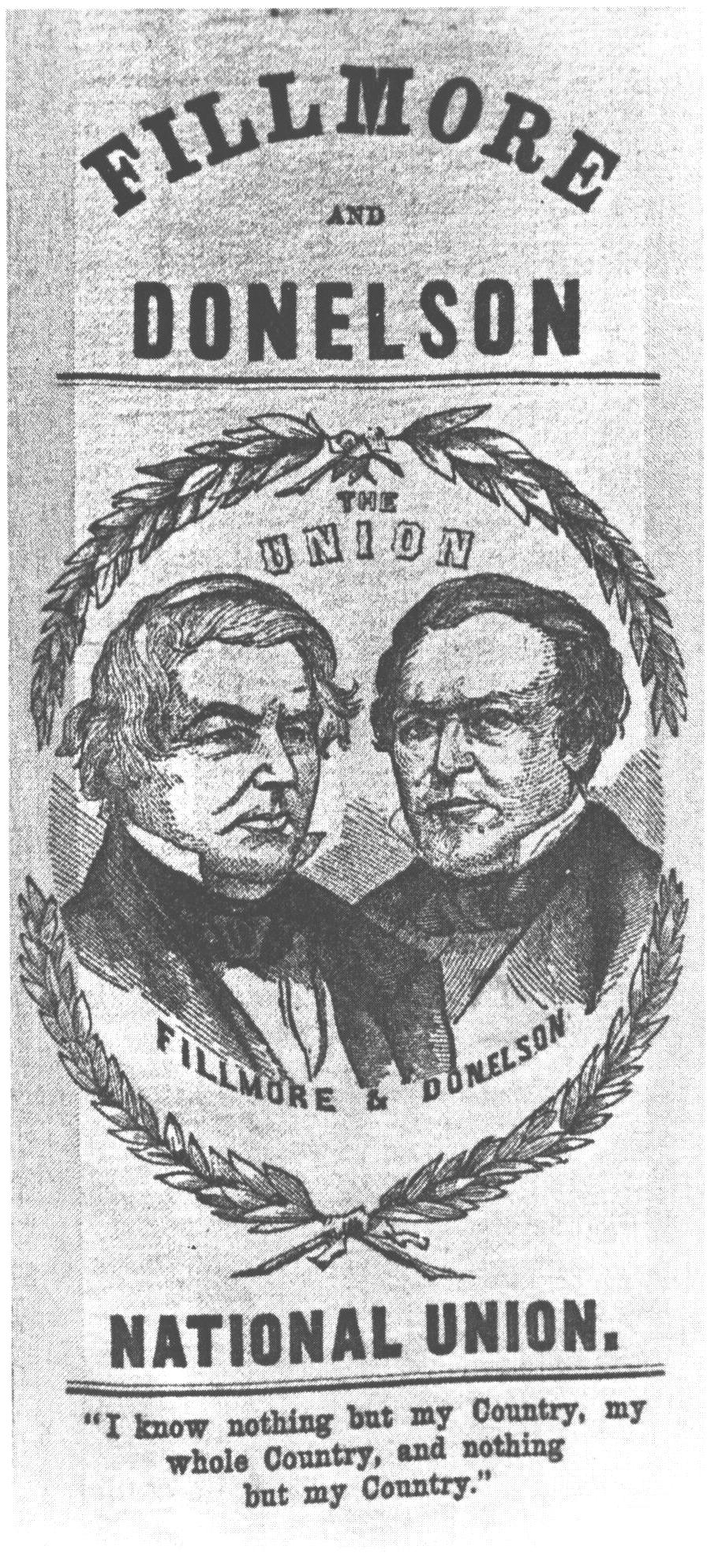

It may seem like this is just what happens in America. But history has details that the broad strokes don't tell you.

Yes, if you add to Nicolle Wallace's words "protectionism", "isolationism", and "nativism" the anti-Muslim anti-Hispanic bigotry of Donald Trump's rhetoric and you might think you have Millard Fillmore reborn, just with Islam substituted for Catholicism.

Except that unlike Trump, Fillmore was a knowledgeable, experienced public official who, when it came to government administration and public policy, "had a clue" as they say.

Prior to his run for President on the American Party ticket, Fillmore was an Inspector of the New York Militia's 47th Brigade with the rank of Major, an attorney, a New York State Assemblyman, a Congressman as a Whig Party candidate, a Vice-President as a Whig, and a President as a Whig after the death of President Zachary Taylor.

In Trump we have as a President someone that spent his life as a con man who gained notoriety as a reality show host. A reality show host....

This happened because we are in a time in which our political discussion has been reduced to the divisiveness of uninformed, dismissive, content-free, frequently hate-filled tweets.

We have literally created in the form of "apps" the mechanism to amplify the worst in ourselves, the worst in America, creating the worst kind of dissidents.

Because those "apps" - whether they are tweets, Facebook posts, or news web sites - generate corporate revenues, they proliferate becoming the source of "The Conventional Wisdom" instead of truthful facts.

For those who do not understand the term "The Conventional Wisdom", economist John Kenneth Galbraith in his 1958 book The Affluent Society prepended "The" to the phrase "conventional wisdom" to emphasize its meaning narrowed to those commonplace beliefs that easily became acceptable and comfortable to society, thus enhancing their ability in the minds of people to resist facts that might diminish or belie them.

In contrast to tweets, offered "for the record" are ruminations on early 21st Century American politics in an historical context, adapting an early-20th-Century-magazine-article-style long-form format divided into 10 more long, though  hopefully provocative and/or informative, blog posts. Below is a linking "table of contents":
  1. Dissidents in American Politics: "Left", "Right", "Conservative" and "Liberal" are Meaningless Labels
  2. Dissidents in American Politics: The 21st Century Political Divisions within a Divided, Disintegrating American Union
  3. Dissidents in American Politics: The History of the Authoritarian Presidency
  4. Dissidents in American Politics: Who are we angry at? The Ethnic Others? Politicians, Congress, State Legislatures? Or the Sort of Rich, Rich, & Stinking Rich?
  5. Dissidents in American Politics: The Shareholder Capitalist Class
  6. Dissidents in American Politics: The Academic Oligarchist Class
  7. Dissidents in American Politics: The Romantic & Mythical in Politics
  8. Dissidents in American Politics: Shareholder Capitalists versus Academic Oligarchists
  9. Dissidents in American Politics: The Prospect of a Revolution and Tyranny led by American Mythical Reactionaries
  10. Dissidents in American Politics: Beliefs, Facts, and  Future Shock


Revised from the Original Post in the Redwood Guardian

Monday, January 1, 2007

History Matters:
  Conquering the Transcontinental Divide by
  Amplifying the Racial and Cultural Divide


A review of the history of the U.S. reaching the Pacific is not complete without discussing the Transcontinental Railroad. Building the Transcontinental Railroad achieved a goal of creating a fast and easy economic and migrant connection between the two coastlines by crossing the Transcontinental Divide, a physical barrier which in earlier times would have assured the existence of a different country on the west side of the divide.

In order to assure a permanent occupation of the area west of the Transcontinental Divide on the map above, during the Civil War President Abraham Lincoln signed the Pacific Railroad Act of 1862 authorizing the creation of two private railroad companies, the Central Pacific in the west and the Union Pacific in the mid-west. The companies were created June 28, 1861, two months after the Civil War began. With the secession of the South, the modernizers in the Republican Party founded in 1854 controlled the US Congress wanted to build the First Transcontinental Railroad.

The 1,912-mile continuous railroad line that connected the existing eastern U.S. rail network at Omaha, Nebraska/Council Bluffs, Iowa with the Pacific coast at the Oakland Long Wharf on the San Francisco Bay was completed in 1869. The new line crossing the Transcontinental Divide reached the Pacific and connected in Omaha to railroads serving the Atlantic Seacoast.

The implementation of that construction is a symbol of the evolving cultural difference between the Pacific States and the states east of the Transcontinental Divide.  The construction could not be done without immigrant workers.

On the east side of the Divide to work for the Union Pacific Railroad came immigrant workers from British-occupied Ireland. They came across the Atlantic from Northern Europe, landing in former British colonies.

Soon signs would appear saying "No Irish Need Apply" partly because of Catholic religion of the Irish and partly because the British cast a discriminatory shadow over the Irish as non-English speaking natives in a colony.

As noted in When the Irish Weren’t White:

    Like finding out a song you thought was new is actually a 100-year-old remake, the Irish were simultaneously accused of stealing all the good jobs and branded as 'lazy' and 'shiftless.' They were also thought to be the nonwhite 'missing link' between the superior European and the savage African based on stereotypes from the early American media....
In British eyes, the Ireland and its indigenous population was not significantly differently from their other colonies such as India or Rhodesia (Zimbabwe). Simply, the Irish weren't WASP.

As early as 1798 Congress passed laws targeting Irish immigrants. In the 1840's the Know-Nothings, a nationalist political group, was the result of a populist movement of poor whites who were dissatisfied with the two-party system and started their own political party, intent on preserving America’s culture by restricting immigration, especially from Catholic countries.

When his party disintegrated over his signing of the Fugitive Slave Act, Whig President Millard Fillmore in 1856 accepted the nomination for President of the Know Nothing (or American) Party, thereby setting a precedent for running as a Know Nothing President.

The immigrant workers on the west side of the Divide came from Asia across the Pacific to what was former Catholic-Spanish Mexican territory to work for the Central Pacific Railroad. They were Chinese, of a different race who spoke a language even stranger than Irish Gaelic.

Ultimately, in the spring of 1882, the Chinese Exclusion Act was passed by Congress and signed by President Chester A. Arthur. This act provided an absolute 10-year moratorium on Chinese labor immigration.

The Chinese Exclusion Act was the first law implemented to prevent a specific ethnic group from immigrating to the United States. It was repealed 61 years later by the Magnuson Act on December 17, 1943. That was after the United States rounded up descendants of immigrants from Japan and put them in concentration camps.

The deliberate effort to have Irish and Chinese workers come to the United States was viewed by those living east of the Transcontinental Divide in much the same way as the 49% viewed the 1803 Louisiana Purchase - those workers were a threat like the free black people and the Catholic French and Spanish living in New Orleans.

Anything about this sound familiar, similar to today?

Table of Contents
WHAT YOU NEED TO KNOW ABOUT
THE PROGRESSIVE PACIFIC MESSAGE
  1. Welcome to the Pacific Progressive Message
    1. Our Core Message
    2. The 70-Year Systematic Destruction of American Progressivism
    3. The Task Facing Progressives
    4. Statement of Obligations and Rights of People and their States
  2. History Matters: The 2016 Bi-Partisan Attack on the Pacific States People, Beliefs, Economy, Defense
    1. Why is it a "Pacific" Message???
  3. History Matters: The Significance of the Spanish Pacific in North American Historical Geography
    1. New Spain (1521-1849): The Real History of American States
    2. How the Spanish Created the 21st Century Pacific States Worldview
  4. History Matters: Conquering the Transcontinental Divide by Amplifying the Racial and Cultural Divide
  5. History Matters: Defending the Endangered Basic Human Rights of the People of the Pacific States
    1. It's not Roger Williams' American Dream
    2. About that Star Spangled Banner National Anthem
  6. Economics Matter, Stupid! Combating the Bi-Partisan Assault on the Enduring Economics of the Pacific States
  7. Wealthy Neoliberals Matter: How an Economic Ideology Took Control of U.S. State and National Legislative Agendas
    1. History Matters: Neoliberalism comes to America
    2. History Matters: The Loss of the Progressive Message in America
    3. History Matters: After Reagan, Neoliberals continue to win
    4. Organization and Drudgery Matter: The Neoliberal Advocacy Network
  8. The Future Matters: Restoring the Lost Progressive Message by Advocating for a Warm, Big-Hearted World
    1. Overcoming the Neoliberal strategy
    2. An Alliance does not equal assimilation or multiculturalism
    3. History Matters: To win it's State Party Politics, not Celebrity
    4. A Goal: Learn to use 21st Century technology to win